
Ship's Online Store

The pride of Evansville, IN LST 325 is the only Navy monument capable of independent movement. LST 325 is a faithful restoration of a working "workhorse of the sea" that carried US soldiers and Marines to war during WWII and Korea. The Memorial is also a tribute to the city's contribution to the war effort which saw 167 LSTs and 34 other ships of various types produced at the local shipyards making Evansville the highest producing of all the inland shipyards.
R. Ruetter, Evansville, Indiana
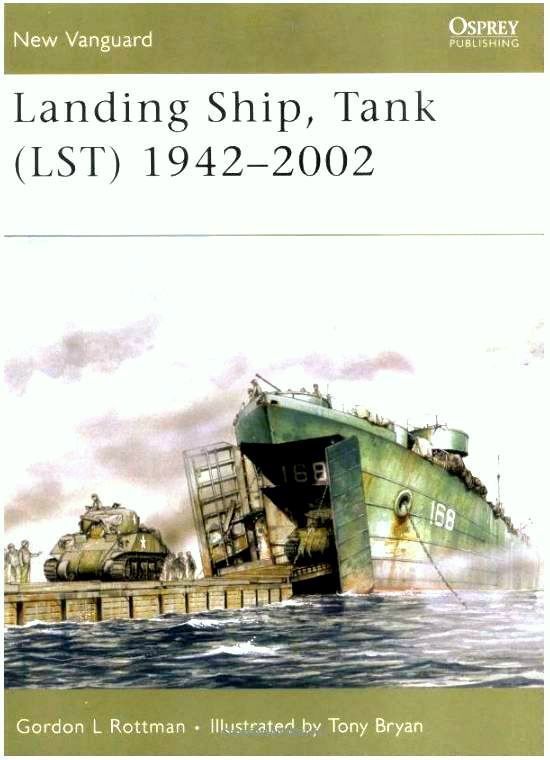
Landing Ship, Tank (LST) 1942-2002
Author Gordon L Rottman
Introduction
The Landing Ship, Tank (LST), know alternatively by its users as “large slow target,” “large stationary target” (when beached, “green dragon” (when in green tropical camouflage), or “manmade whale,” is probably one of the better known World War II amphibious ships. It is the largest beaching vessel capable of discharging cargo directly ashore and extracting itself.
The LST saw service from 1942 until 2002 when the last LST in the US Navy was decommissioned. Production lasted through World War II and small numbers of improved LST classes were built in 1973. Besides exceeding expectations, the LST fulfilled all sorts of unforeseen roles, with a number converted to specialized auxiliaries.
LST’s were designed to disembark large quantities of vehicles, equipment, supplies, and materiel without the necessity of prepared dock facilities or the need for cranes necessary to unlad cargo ships. They gave the Allies the ability to conduct amphibious invasions on foreign shores at any location that had a gradually sloped beach and suitable beach exit routes. This ability permitted the Allies to assault pooly defended sectors rather than being forced to seize seaports.
Seagoing amphibious landing vessels over 200ft in length were designated “landing ships” and included the LST. Smaller vessels were designated “landing craft.” Major variants were further identified by a mark number; for example, the landing ship, tank MKII was abbreviated LST(2). Both the US and Britain shared the same designation system with mark numbers crossing international lines.
LST’s were the largest ships to be identified only by Bureau of Ships (BuShips) hull numbers, 1 through 1152 with gaps as 100 LST’s were cancelled in 1942, The remaining 158 post-war LST’s converted to auxiliaries also received names preceded by “USS,” as well as new classification letters and hull numbers.